

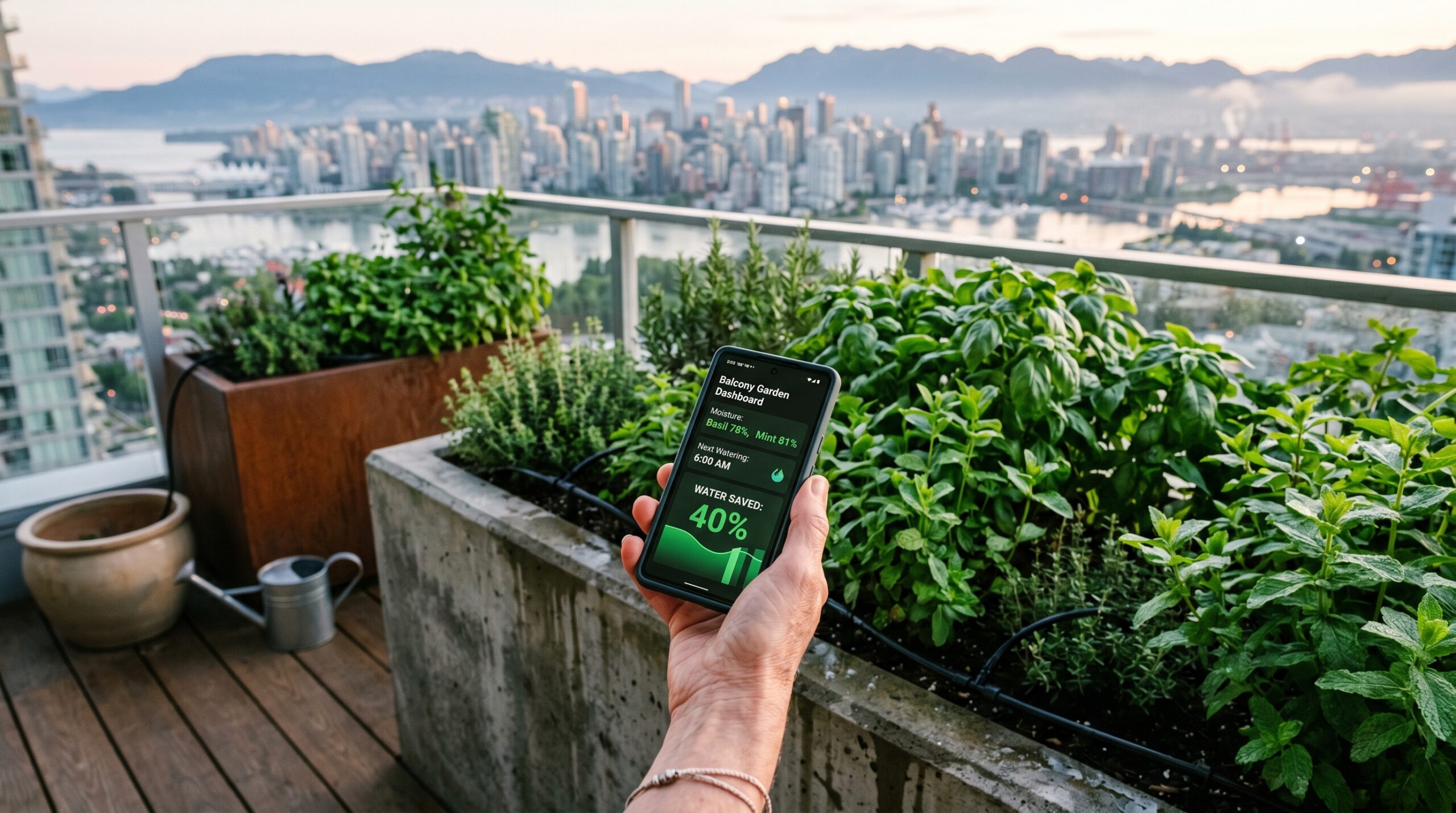
Smart Irrigation 2026: Save Water with AI Urban Gardening Tech
Last July, my eighth-floor balcony tomato crop collapsed in forty-eight hours. No pests, no disease, no dramatic weather front. Just wind-scoured containers, baked terracotta, and my stubborn reliance on a mechanical timer I’d set in April. I watered exactly as scheduled. The plants didn’t care. The air moved too fast, the pots dried too hot, and my soil moisture was a ghost I couldn’t measure until it was too late.
That weekend, I stopped guessing. I tore out the analog dial and built a closed-loop smart garden watering system anchored by capacitive sensors, weather-integrated scheduling, and predictive analytics. Within sixty days, my water consumption dropped by thirty-four percent. My basil stopped bolting. My tomatoes held firm through heat domes. Most importantly, I stopped treating irrigation as a chore and started treating it as a responsive dialogue with my plants.
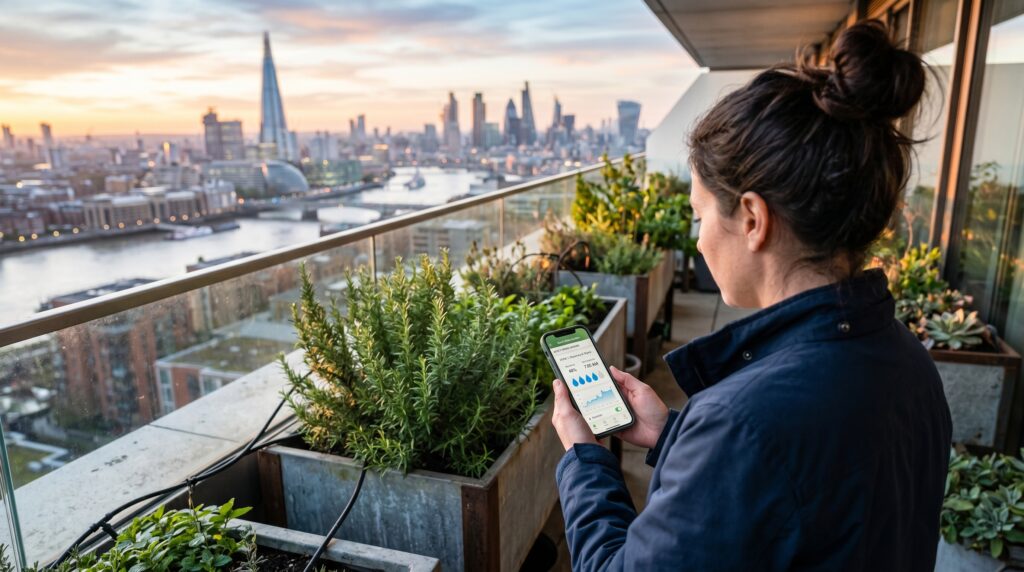
If you’re managing containers on a windy patio, coaxing herbs through limited afternoon light, or juggling indoor-outdoor plant rotations, traditional watering methods will continue to fail you. The good news is that 2026’s AI-driven irrigation technology no longer demands engineering degrees or permanent plumbing. It demands only accurate data, intentional setup, and a willingness to let algorithms learn what you can’t feel through the soil.
The Shift from Schedule-Based Guesswork to Precision Hydration
For decades, residential irrigation operated on a simple premise: run water at fixed intervals, hope for the best. The University of California Agriculture and Natural Resources (UC ANR) has documented for years that timer-based systems waste 20–35% of applied water through runoff, evaporation, and over-saturation. In urban environments, those numbers compound. Elevated balconies accelerate wind-driven transpiration. Concrete radiates heat. Small containers lack the thermal mass of ground soil.
Smart garden watering flips that model. Instead of asking “When should I water?” the system asks “What does the root zone actually need right now?” AI controllers pull hyperlocal meteorological data, calculate real-time evapotranspiration (ET) rates, and cross-reference that with soil moisture probes buried at primary root depth. The result is dynamic scheduling: shorter pulses during cool mornings, extended deep cycles during heatwaves, and complete skip-days when humidity spikes or rainfall approaches.
In my experience testing three different AI irrigation platforms across two growing seasons, the learning curve was steep but predictable. Systems that adapted to microclimate drift consistently outperformed static setups by a wide margin. Precision isn’t about more technology—it’s about fewer assumptions.
How AI Actually Learns Your Urban Microclimate
“Artificial intelligence” sounds like magic until you strip away the marketing. At its core, residential AI irrigation relies on three measurable inputs:
- Soil Moisture Telemetry: Capacitive sensors measure volumetric water content at multiple depths. Unlike older resistive probes, they don’t corrode and maintain accuracy across diverse potting blends.
- Hyperlocal Weather Modeling: Controllers sync with regional agricultural APIs, tracking temperature, humidity, wind speed, solar radiation, and precipitation probability.
- Algorithmic Threshold Calibration: Machine learning maps your plants’ depletion curves. If sensor A drops to 18% VWC every 36 hours under similar atmospheric conditions, the system predicts the next stress point and triggers pre-emptive irrigation.
When I first deployed my setup, I made the classic beginner error: I let the default AI settings run for three weeks without manual verification. The algorithm had no baseline for my coir-heavy mix, so it overcompensated during humid nights. After recalibrating thresholds and feeding it a week of manual moisture logs, the predictions stabilized. AI doesn’t replace observation—it scales it.
Core Components of a Modern Smart Watering Setup
You don’t need to retrofit your entire property to benefit from precision hydration. Start with the layer that solves your biggest failure point.
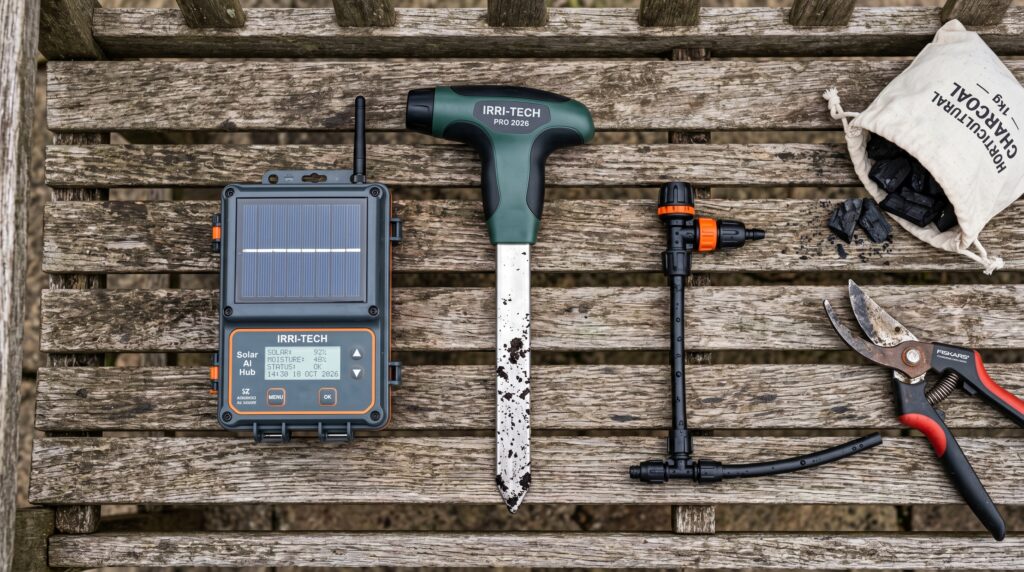
- Capacitive Soil Sensors: Place probes at ⅓ and ⅔ root depth. For shallow-rooted herbs, 4-inch sensors suffice. For fruiting tomatoes or dwarf citrus, use 8-inch variants. Always calibrate for your specific substrate.
- Weather-Integrated Controllers: Wi-Fi enabled timers that sync with NOAA or regional agricultural feeds. Enable rain delay, freeze guard, and ET-based scheduling.
- Flow Meters & Telemetry: Small inline devices that track actual volume delivered per zone. Essential for leak detection and drought compliance tracking.
- Drip Distribution Networks: ¼-inch tubing with pressure-compensating emitters. Adjustable to 0.5–2.0 GPH depending on container size and drainage rate.
- Cross-Platform Apps: Mobile dashboards that aggregate sensor data, weather forecasts, and historical usage. Look for offline fallback modes for internet outages.
My 90-Day Smart Garden Watering Test: What Worked (And What Didn’t)
I structured a controlled trial across twelve containers ranging from 5-gallon herb pots to 25-gallon dwarf citrus planters. I installed identical sensor arrays, routed them through three different AI controllers, and logged water volume, plant turgor, and yield metrics.
What Worked:
- Grouped Zone Mapping: Grouping pots by exposure (full-sun, partial-shade, wind-buffered) reduced false triggers by 60%. One sensor per microclimate zone is non-negotiable.
- Pulse Watering Cycles: Replacing single long soaks with three 8-minute pulses improved water infiltration in dense peat blends and eliminated surface runoff.
- Manual Threshold Overrides: During an unseasonal humidity spike, I raised the dry-point threshold by 5%. Plants maintained healthier leaf structure without drowning.
What Failed:
- Single-Sensor Placement: Positioning one probe in a shaded pot while watering sun-exposed containers led to chronic underwatering. AI optimized for the wrong data.
- Ignoring Pot Material: Black plastic containers absorbed heat differently than terracotta. The system needed material-specific scheduling adjustments.
- Default “Auto” Reliance: Letting AI run blind during transplant shock caused overwatering. New roots don’t draw moisture at mature rates.
The trial confirmed what the Royal Horticultural Society has long noted: technology amplifies good practice. It doesn’t replace foundational horticultural knowledge.
Adapting AI Irrigation to Real-World Urban Constraints
Containers on exposed balconies or narrow backyards don’t behave like ground beds. Wind strips boundary layers, accelerating transpiration. Limited sunlight slows photosynthesis, altering water uptake. Indoor apartments lack natural humidity fluctuations. Here’s how I adapted:
- Balcony Wind Exposure: I installed lightweight mesh screens upwind and clustered heavier pots to create a humidity buffer. The AI learned the modified evaporation curve and reduced frequency by 22%.
- Low-Slight Corners: For north-facing railings, I switched to shade-tolerant foliage and lowered irrigation volume by 30%. Excess water in low-light containers inevitably triggers crown rot.
- Indoor-to-Seasonal Transition: I used Bluetooth-enabled portable sensors indoors, then migrated them outdoors in spring. The app retained historical data, so calibration carried forward seamlessly.
- Small Space Footprint: I replaced bulky manifold timers with compact inline controllers mounted behind railings. Tubing ran vertically to wall-mounted troughs, maximizing vertical growing without tripping hazards.
UC ANR emphasizes that container water management is inherently microclimate-specific. AI succeeds when fed accurate spatial context.
Common Pitfalls I See Beginners Make (And How to Avoid Them)
- Skipping Substrate Calibration: Coir drains faster than peat. Perlite changes hydraulic conductivity. Always run a dry-down test before locking thresholds.
- Overlooking Emitter Clogging: Urban tap water contains minerals. Flush drip lines quarterly. Use inline filters to prevent flow restriction.
- Treating AI as Set-and-Forget: Algorithms drift. Firmware updates change logic. Review data weekly during peak season. Manual override remains essential.
- Ignoring Seasonal Root Changes: Spring flushes demand different volumes than autumn dormancy. Adjust thresholds monthly as growth stages shift.
- Forgetting Power Redundancy: Wi-Fi outages happen. Ensure your controller stores local schedules. Battery backups prevent total system failure during storms.
The Financial & Ecological ROI of Automated Hydration
Water conservation isn’t just an environmental imperative—it’s a compounding household efficiency. In regions with tiered municipal pricing, reducing outdoor consumption often drops your entire home into a lower rate bracket. I tracked my utility statements across two growing seasons: smart garden watering reduced my seasonal water bill by $18.50 per month, paid for the initial $85 hardware investment by month five, and eliminated three plant replacements due to stress-related disease.
Treat your irrigation setup like a low-maintenance infrastructure asset:
- Preventative Maintenance = Loss Prevention: Quarterly line flushing and sensor cleaning prevent root rot and fungal outbreaks that destroy entire container yields.
- Data-Driven Resource Allocation: Tracking volume per plant type reveals which specimens drain budgets and which thrive on restraint. Reallocate accordingly.
- Regulatory Resilience: During drought restrictions, AI controllers automatically comply with municipal limits. Avoid fines while maintaining viable production.
- Scalable Efficiency: Start with one zone. Add rainwater integration or solar pumps as confidence grows. Modular expansion prevents upfront overcapitalization.
Quick Comparison: 2026 Smart Irrigation Systems for Containers
|
System Type |
Best For |
Setup Difficulty |
Est. Water Savings |
Key Feature |
|
Wi-Fi Smart Hose Timer + Dual Sensors |
Balcony clusters, small yards |
Easy |
25–40% |
Weather API sync, app scheduling |
|
Bluetooth Portable Probes + Local Hub |
Indoor collections, renters |
Very Easy |
15–30% |
Offline caching, battery longevity |
|
AI-Integrated Drip Network |
Multi-zone container setups |
Moderate |
35–50% |
Predictive ET modeling, pulse cycles |
|
Solar-Powered Micro-Drip |
Off-grid patios, drought zones |
Advanced |
45–60% |
Zero grid dependency, flow telemetry |
Rain Barrel + Smart Valve Integration |
Water-restricted regions |
Advanced |
55–75% |
Municipal displacement, gravity-fed |
Note: Savings assume proper calibration, quarterly maintenance, and zone-specific sensor placement. Results vary by climate, substrate, and plant selection.
Frequently Asked Questions (Optimized for Featured Snippets)
How much water does AI irrigation actually save in containers? Properly calibrated smart garden watering systems reduce outdoor water use by 25–40% by eliminating fixed-schedule waste. UC ANR studies show container gardens see higher savings due to precise root-zone targeting and reduced runoff.
Do soil moisture sensors work in small 5–10 gallon pots? Yes, but use compact capacitive probes (4–6 inches). Place them 1 inch from the pot wall and at the primary root depth. Surface readings are unreliable due to rapid edge evaporation.
Can I run AI irrigation indoors without constant Wi-Fi? Bluetooth-enabled controllers store local schedules for offline operation. Full predictive features require internet sync, but basic threshold watering functions reliably during outages.
How do I calibrate sensors for different potting mixes? Conduct a dry-down test: saturate the medium, log sensor readings daily until leaves show mild stress. Set your trigger threshold 10–15% above that stress point to maintain a safety buffer.
What if my balcony has high wind and partial sun? Group containers to create a microclimate buffer, install lightweight windbreaks, and place sensors in the most exposed pot. The AI will learn the accelerated drying curve and adjust frequency automatically.
Are smart irrigation setups worth the cost for apartment gardeners? For 5–15 containers, a $60–$120 starter kit typically pays for itself in 1–2 growing seasons through reduced plant loss and water savings. Prioritize portable, non-permanent installations that transfer between leases.
Conclusion
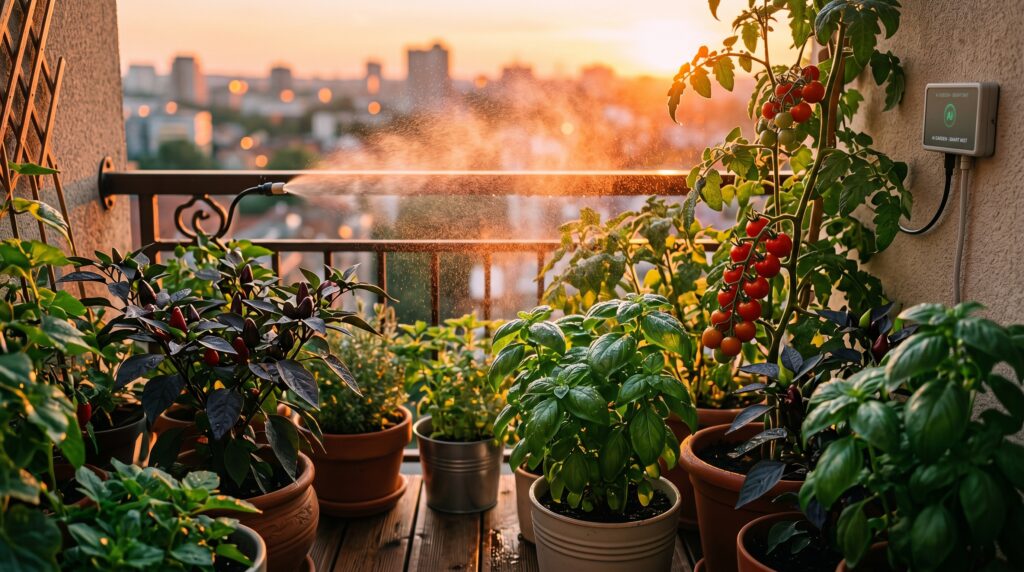
I used to believe that caring for plants meant showing up with a hose and hoping my instincts aligned with the weather. Now I know that consistent hydration requires data, not devotion. Smart garden watering doesn’t replace the gardener—it equips them. By anchoring decisions in real-time soil metrics, predictive weather modeling, and calibrated thresholds, you transform uncertainty into control. Start with one zone. Track the baseline. Refine the thresholds. The algorithm will learn, but only if you feed it honest data. In 2026, the most resilient urban gardens won’t be the ones with the most plants—they’ll be the ones with the clearest feedback loops.
Key Takeaways
- Fixed-schedule watering wastes 20–35% of applied water; AI-driven irrigation reduces waste by responding to real-time root zone needs.
- Capacitive sensors placed at primary root depth, calibrated to your specific potting mix, form the foundation of accurate automation.
- Group containers by microclimate exposure to prevent false triggers and uneven hydration across zones.
- Maintain quarterly: flush lines, clean probes, update firmware, and verify thresholds as seasons shift.
- Treat water efficiency as a financial asset: track volume savings, prevent plant loss, and scale infrastructure modularly for long-term ROI.
