

Last April, my balcony overlooking Liberty Village was a graveyard of rusted chairs and dead potting soil. Like many of us living in the GTA, I treated my outdoor space as a seasonal storage locker. But with grocery prices rising and the need for a “sky-high sanctuary” becoming real, I decided to engineer a transformation.
This isn’t just a design guide; it’s a post-mortem of what actually works when you’re dealing with the unique micro-climate of a North American high-rise. Here are the 7 secrets I used to maximize curb appeal while keeping my sanity..
Before you click away, disappointed that I brought up something as practical and boring as small urban balcony transformation design secrets, hear me out. My intent is to provoke your spirit to start today.
7 Urban Balcony Design Secrets
1. The 100-lb Rule: Engineering for Skyscrapers
The first mistake I made years ago was buying heavy clay pots. By the time I added wet soil and a tomato plant, I was terrified for my structural integrity.
My Secret: I switched entirely to lightweight fabric grow bags and resin “faux-stone” planters.
- The Math: A 10-gallon ceramic pot weighs ~40 lbs empty. A fabric bag weighs 1 lb.
Experience Tip: In Toronto, we get those biting lake winds in April. I line the bottom of my fabric bags with 2 inches of lava rock. It adds just enough “ballast” to keep the pots from sliding in a storm without exceeding the weight limit of a standard balcony (typically 50-100 lbs per sq. ft.).
Also Read: Sky-High Gardening: My Top 10 Wind-Resistant Plants for High-Rise Balconies
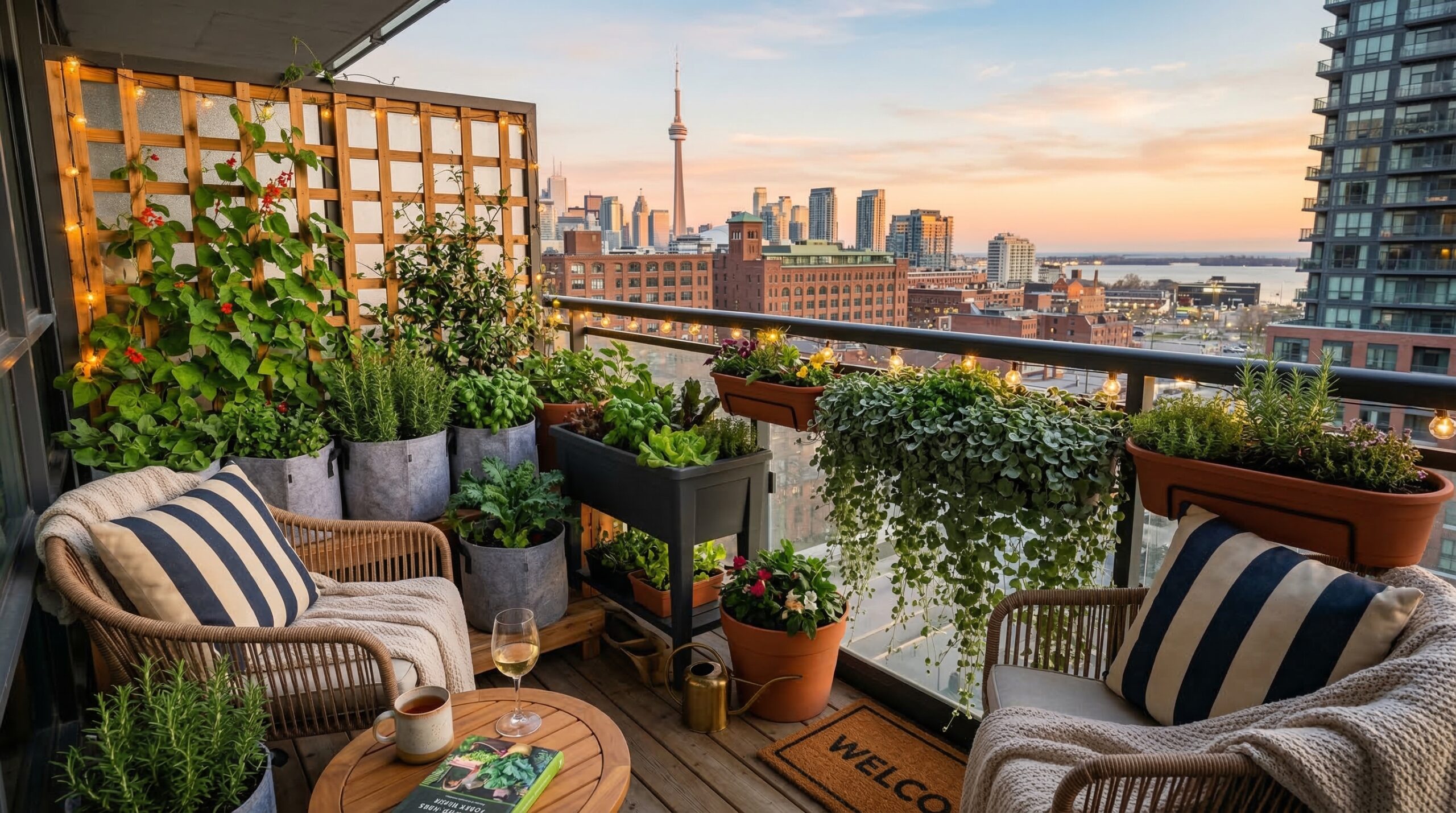
2. Defeating the “Wind Tunnel” Effect
On the 14th floor, wind is a more aggressive killer than frost. I watched my first batch of delicate herbs get shredded in 48 hours.
My Secret: Create a “Living Windbreak.” I installed a modular cedar trellis on the windward side of the balcony. Instead of a solid wall (which acts like a sail and can blow over), the trellis breaks the wind into smaller, harmless eddies.
- Plant Choice: I grew Star Jasmine and Scarlet Runner Beans up the trellis. They are hardy enough to take the gust and provide a “green screen” that protects my more sensitive “spiller” plants like trailing petunias.
3. Curb Appeal starts with “The Spiller”
If you want your balcony to look world-class from the street, you have to design for the people looking up.
My Secret: I prioritize “The Spiller” in my railing planters. While I love my herbs, they aren’t visible from the sidewalk. I now inter-plant my kale and chives with Silver Falls Dichondra. It cascades nearly three feet down the side of the building.
- The Result: From the street, my balcony looks like a lush, hanging forest, which dramatically increases the “curb appeal” of the entire unit.
4. Smart Watering for the “Weekend Warrior”
I used to travel for work, and I’d come home to a “hay balcony.” Manual watering in a windy environment is a losing battle because the wind pulls moisture out of the pots twice as fast.
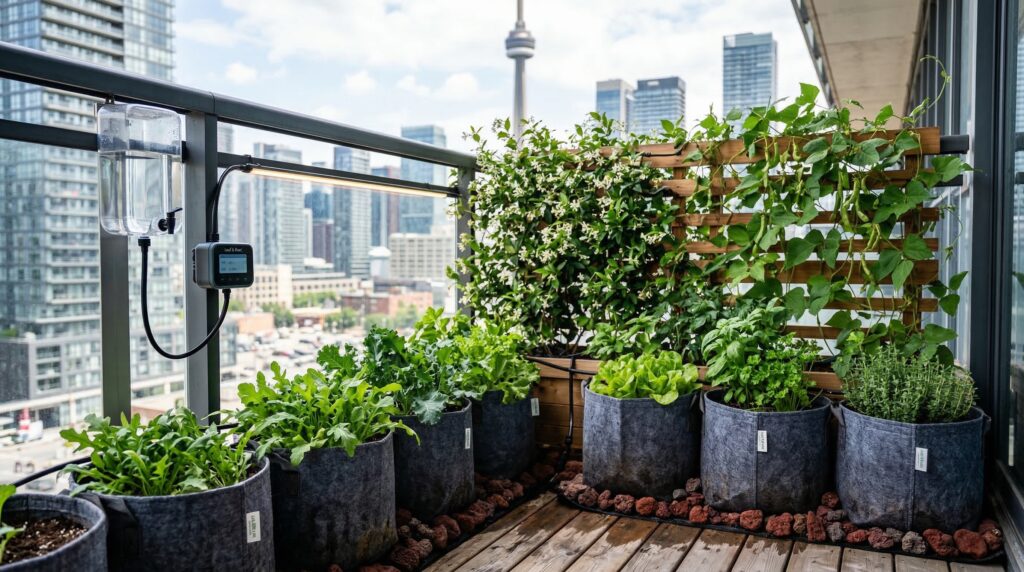
My Secret: I installed a Bluetooth-connected hose timer (I use the Orbit B-hyve) attached to a 2-gallon gravity reservoir.
- Why it Wins: Even if I’m in Montreal for the weekend, I can check my phone and see that my balcony was watered at 6:00 AM. In 2026, “Smart” isn’t a luxury; it’s the only way to ensure your ROI (Return on Investment) on expensive plants.
5. The “Bokashi” Nutrient Cycle
In a 600-square-foot apartment, traditional composting is impossible—the smell alone is a lease-breaker.
My Secret: I started a Bokashi bin under my kitchen sink. It’s an anaerobic fermentation process that handles meat and dairy (unlike worms) and has zero odor.
The “Gold” Liquid: Every week, I drain the “Bokashi tea” and dilute it to water my balcony. This organic liquid gold is why my “Patio Princess” tomatoes produced 3x more than my neighbor’s last year.
SmartWealth Tip: The “Micro-Farm” Dividend
In 2026, a smart urban garden is a financial asset.
- The ROI of Herbs: A single $6.00 organic Mint or Basil starter plant from a local nursery (like Davenport Garden Centre) can yield over $80.00 worth of produce across a single Toronto summer.
- The Wealth Strategy: Instead of buying “disposable” annual flowers every year, invest in perennials like Chives or Sage that survive the Ontario winter in insulated pots. You pay once, and they “pay out” a harvest dividend every spring for years.
6. Managing the “Condo-Clog” (Drainage Etiquette)
Nothing ends a “Green Oasis” dream faster than a cease-and-desist letter from your condo board because you’re dripping muddy water onto the person below you.
My Secret: Deep Saucer Integration. I never buy a pot without a matching, deep-well saucer.
Pro Tip: I use “pot feet” (small rubber risers) inside the saucers. This keeps the pot from sitting in stagnant water (preventing root rot) while ensuring that 100% of the runoff is contained.
7. Lighting for the “After-Hours” Oasis
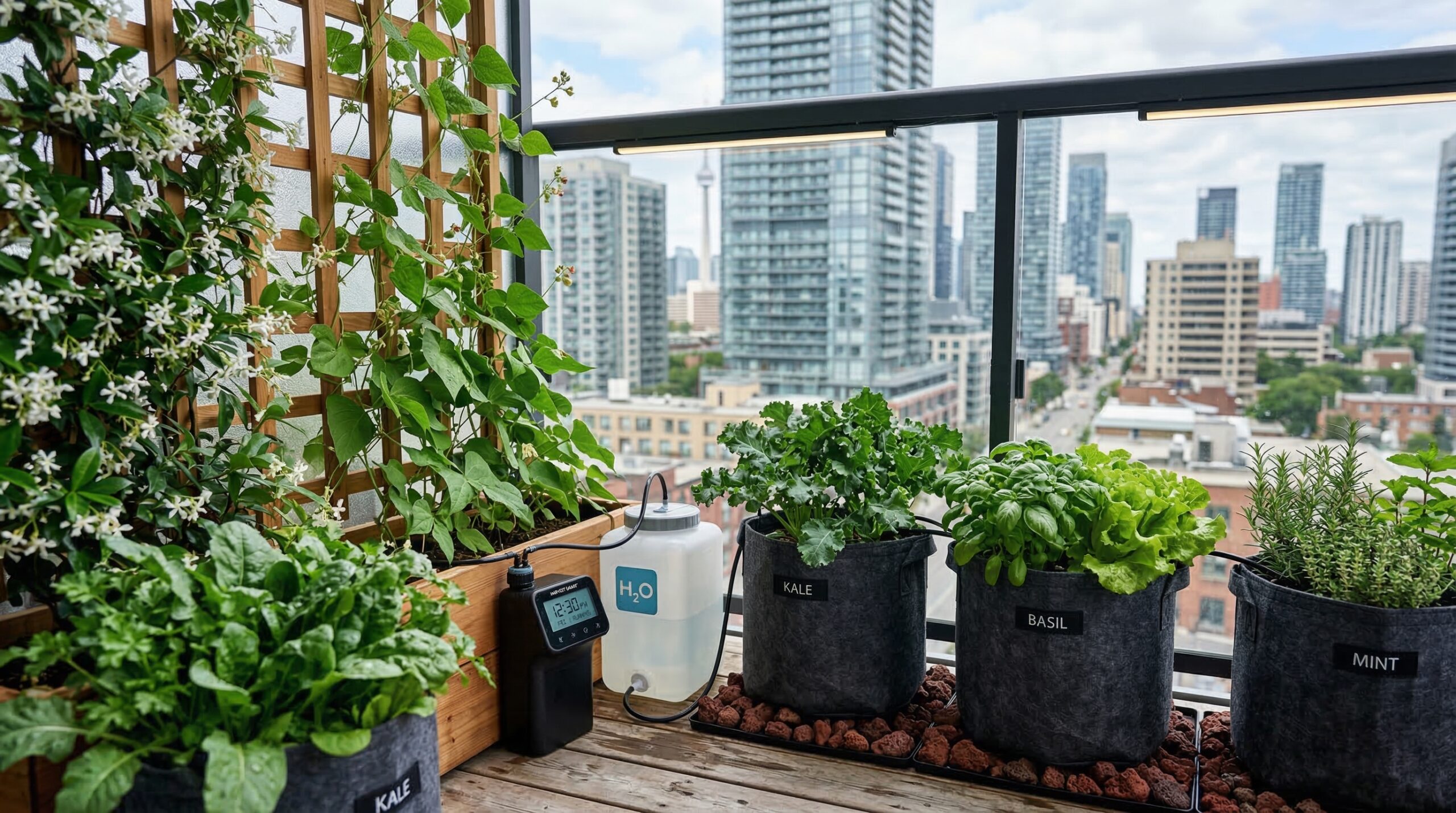
Most people design their gardens for the daytime. But in the city, we enjoy our balconies most between 7:00 PM and 11:00 PM.
My Secret: I avoided the “cheap solar” trap. Solar lights rarely get enough charge on a North-facing balcony. I invested in USB-rechargeable LED magnetic bars that I snap onto my railing under-side.The Vibe: It creates a “down-light” effect similar to a high-end hotel lounge, making the balcony feel like an extension of my living room.
Toronto-Specific Urban Planting Calendar (2026)
Note: These dates are adjusted for the “Urban Heat Island” effect common in downtown Toronto (Liberty Village, CityPlace, etc.), where nighttime temps are often 2–3°C warmer than the suburbs.
| Category | Typical Start Date | Key Crops for Balconies | Frost Tolerance |
| Early Spring | April 10 – 20 | Spinach, Kale, Radishes, Peas | High (Can take a light freeze) |
| Mid-Spring | April 25 – May 5 | Lettuce, Beets, Carrots, Chard | Moderate (Survives 0°C) |
| Victoria Day | May 18 – 25 | Tomatoes, Peppers, Basil | Zero (Must stay above 10°C) |
| Summer Peak | June 10+ | Cucumbers, Eggplant, Melons | Prefers consistent hea |
Analyst Note: The “Victoria Day Rule” is a classic Toronto benchmark, but for 2026, keep a close eye on Lake Ontario’s water temperature. Cold lake breezes can trigger “Micro-Frosts” on low-level balconies even when the city forecast looks clear..
Frequently Asked Questions: Urban Balcony Gardening 101
1. When is the safest time to start planting on a Toronto balcony?
While the official last frost date for Toronto is typically early May, the “Urban Heat Island” effect in the downtown core often allows for hardy greens (kale, spinach) to go out in mid-April. However, for “tender” plants like tomatoes or basil, the golden rule in Ontario remains: Wait until after the Victoria Day long weekend to avoid a late-season cold snap.
2. How much weight can my condo balcony actually hold?
Most modern high-rise balconies in North America are engineered to support a “live load” of 50 to 100 pounds per square foot (psf). To stay safe, prioritize lightweight materials: choose fabric grow bags over ceramic pots, and use a soilless potting mix rather than heavy topsoil.
3. What are the best plants for a very windy high-rise balcony?
Wind is the #1 killer of urban plants. The best choices are those with flexible stems or waxy leaves that resist dehydration. Ornamental grasses, Lavender, Sedum, and Swiss Chard are incredibly resilient. Avoid large-leaf plants like Banana palms or Monstera, which the wind can easily shred.
4. How do I prevent watering runoff from bothering my neighbors?
In a condo environment, “drainage etiquette” is essential. Always use deep-well saucers under every pot. For hanging railing planters, look for “self-watering” models with internal reservoirs that prevent overflow. Another pro-tip: Place a boot tray or an outdoor rug under your main plant cluster to catch any accidental splashes.
5. Can I grow food on a balcony that doesn’t get much sun? Yes!
While “fruiting” plants like tomatoes need 6–8 hours of direct sun, “leafy” and “root” plants are much more forgiving. If your balcony is shaded by other buildings, focus on Lettuce, Arugula, Mint, Parsley, and Chives. These can thrive with as little as 3–4 hours of indirect light.
6. Why is my balcony garden drying out even when I water it daily?
This is usually caused by the “Wind Tunnel” effect. High-altitude winds accelerate evaporation from both the leaves and the soil. To fix this, apply a one-inch layer of mulch (like cedar chips or straw) to the top of your pots to lock in moisture, and consider a simple automated drip irrigation system for consistent hydration.
7. Are there specific condo bylaws in Toronto regarding balcony gardens?
Most Toronto condos allow plants, but many forbid anything “hanging over” the outside of the railing for safety reasons. Always check your specific Status Certificate or Building Rules. Generally, as long as your planters are secure, don’t interfere with the building’s exterior aesthetic, and don’t cause drainage issues, you are in the clear.
Final Thoughts from the Sky-High Garden
Transforming a Toronto balcony isn’t about having a green thumb; it’s about acknowledging the engineering constraints of the city. Start with one railing planter, automate your water, and respect the wind. Your 10 square feet of concrete is capable of more than you think.
