

Walking out for an evening walk to your balcony after a storm only to find your prize-winning tomato plant snapped in half or your Japanese Maple looking like it was hit by a blowtorch, you’ve experienced the “Skyscraper Gale.”
When I first moved into my 22nd-floor apartment, I assumed gardening would be the same as it was in my mother’s backyard. I was wrong. I spent over $400 that first spring on “pretty” plants that were dead by June. What I didn’t realize is that high-altitude wind doesn’t just blow plants over—it physically “burns” them through a process called desiccation.
After three years of trial, error, and a fair amount of plant heartbreak, I’ve engineered a list of the most “bulletproof” plants that can survive the 50km/h gusts common in cities like Chicago, Toronto, and NYC.
The Science of the “Wind Burn”
Before we get into the list, you need to understand why your plants are dying. At high altitudes, wind pulls moisture out of the leaves faster than the roots can suck it up from the soil. This leads to “leaf scorch,” where the edges turn brown and crispy even if the soil is wet. To win, you need plants with small, waxy, or needle-like leaves that have a low surface area.
Top 10 Wind-Resistant Survivors
1. Blue Star Juniper (The Foundation)
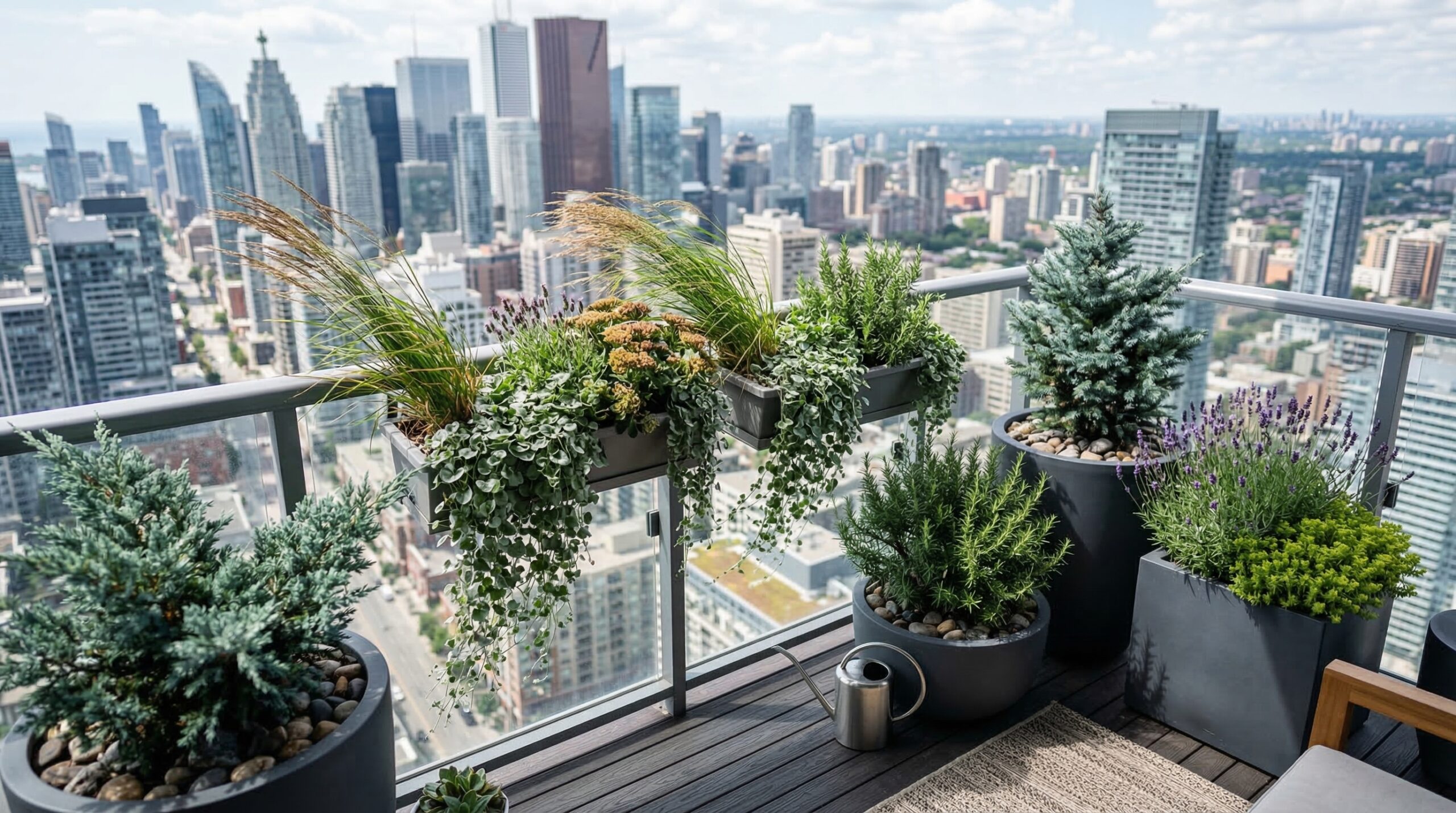
If you want something that literally laughs at a gale, this is it. Junipers have needle-like leaves that offer almost zero wind resistance. I use these as my “outer rim” plants—they take the brunt of the wind and create a micro-climate of calm air for the more sensitive plants sitting behind them on the balcony floor.
2. Ornamental Grasses (Blue Oat Grass or Maiden Grass)
Grasses are the ultimate wind-adapted species. Instead of fighting the wind, they dance with it. I’ve watched my Blue Oat Grass bend 90 degrees during a summer thunderstorm and bounce right back. Plus, the sound of wind rustling through tall grass on a balcony is one of the most relaxing sounds in the city..
Also Read: I Transformed My Small Balcony for Spring: 7 Urban Design Secrets
3. Sedums (Autumn Joy)
Sedums are succulents. Their leaves are thick, waxy, and full of water. This “internal reservoir” makes them incredibly resistant to the drying effects of high-altitude winds. I’ve left my Autumn Joy sedums for a week in July without watering, and they didn’t even flinch.
4. Lavender (Munstead or Hidcote)
Not only does it smell like a Mediterranean vacation, but Lavender is a high-altitude native. Its silver-grey, narrow leaves are evolved to reflect sunlight and conserve moisture in windy, rocky environments.
My Tip: Ensure your pot has incredible drainage; Lavender hates “wet feet” even more than it loves wind.
5. Silver Falls Dichondra (The Spiller)
For that “lush” look, you need a plant that hangs over the edge. Most trailing plants (like Ivy) get shredded by the wind. Silver Falls, however, has tiny, tough, fan-shaped leaves. It looks like a waterfall of silver mercury, and it’s surprisingly resilient to being whipped against the side of a concrete building.
6. Boxwood (The Living Wall)
If you want a privacy screen, skip the plastic lattice and go for a row of Boxwoods. Their small, leathery leaves are wind-tough. I keep mine in long, rectangular resin planters to create a “green fence” that blocks the wind from my seating area.
7. Rosemary (The Edible Shield)
Rosemary is the “Junipers’ cousin” of the herb world. Its needle-like leaves make it the only culinary herb that I can reliably grow on the outermost railing of my balcony. It can handle the heat, the wind, and the occasional neglect.
8. Potentilla (The Shrubby Survivor)
Often found in North American parking lots because they are “unkillable,” Potentilla produces beautiful yellow flowers all summer. They are woody shrubs, meaning they have a solid structure that won’t snap when the gusts pick up.
9. Bay Laurel (The Potted Tree)
If you want a tree-like vibe without the “sail” effect of a maple, Bay Laurel is your friend. Its leaves are thick and tough (think of the dried bay leaves you use for soup). I’ve found it’s much harder than citrus trees for high-rise living.
10. Chives (The Indestructible Herb)
While cilantro and basil wilt the moment the wind picks up, Chives are like grass. They are flexible, hardy, and even if they get flattened by a storm, they grow back within days.
My “Skyscraper-Proof” Design Hacks
Over the years, I’ve learned that what you plant is only 50% of the battle. The other 50% is how you plant it.
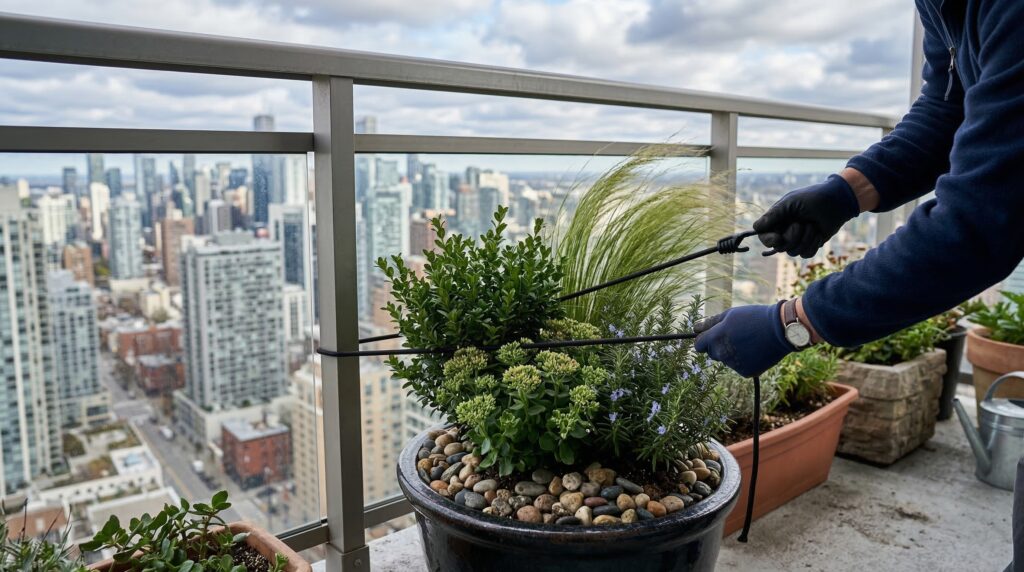
The “Weight Ballast” Trick: Wind can turn a lightweight pot into a projectile. I always fill the bottom 3 inches of my planters with heavy river stones before adding soil. This lowers the center of gravity and keeps the pot anchored.
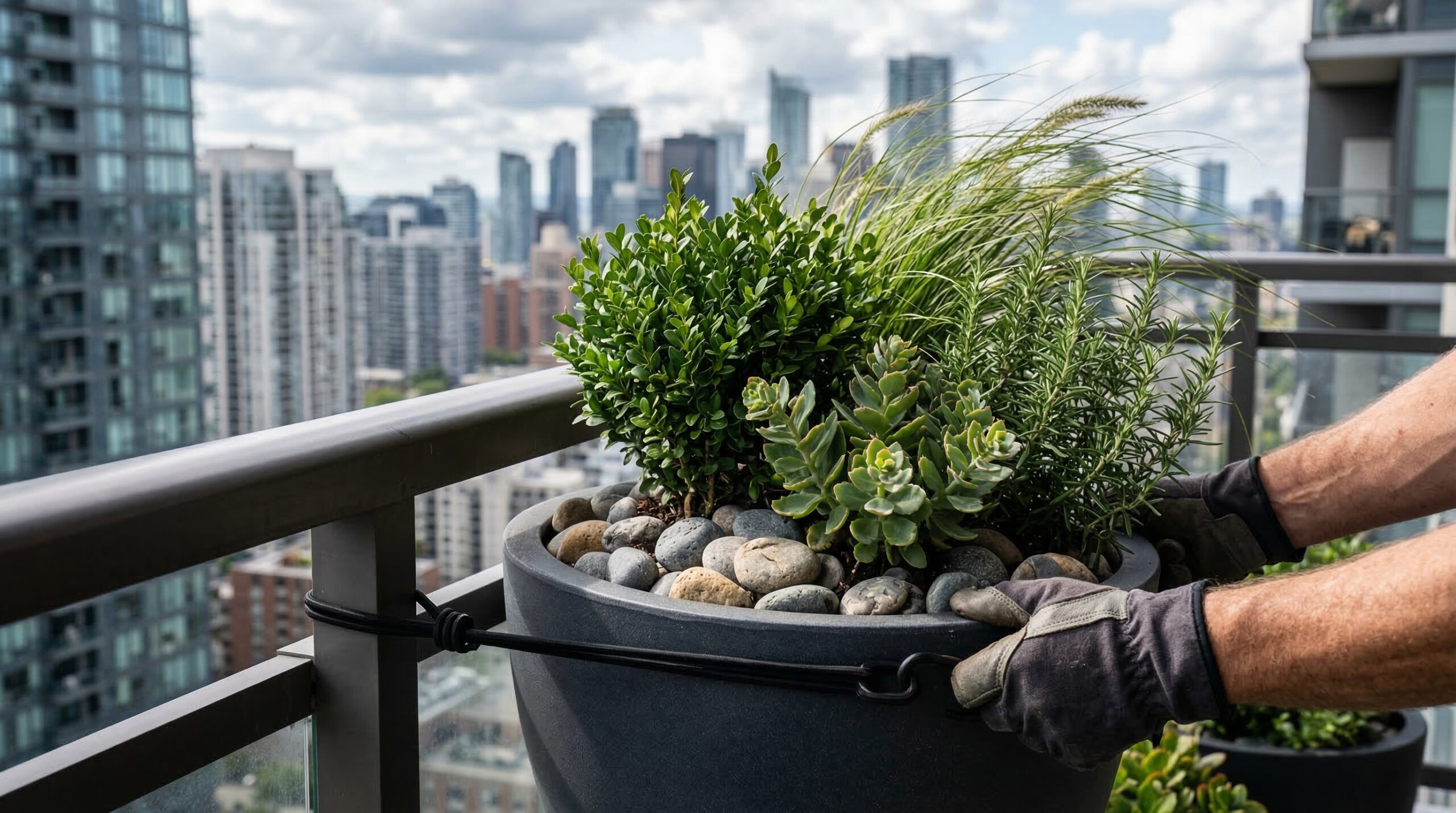
Bungee Cord Anchors: For my taller plants, I use black bungee cords to subtly anchor the pots to the balcony railing. It’s invisible from the street but provides that extra bit of insurance during a “Micro-Burst.”
The “Huddle” Strategy: During high-wind warnings, I move my plants into a “huddle” against the building wall. Plants are social creatures; they protect each other by creating a collective windbreak.
Avoid lightweight wood chips; they will blow into your living room or onto your neighbors. Instead, use heavy river pebbles or crushed slate as a mulch. It looks modern, stays put in a gale, and does a fantastic job of locking in soil moisture.
SmartWealth Tip: The “Perennial Dividend” Strategy
- In the city, we often fall into the trap of buying “annuals” (plants that die every year) because they are cheap at the grocery store. However, for a high-rise garden, this is a poor financial move.
- The Strategy: Invest in hardy perennials (like the Sedums and Junipers mentioned above). While a high-quality Blue Star Juniper might cost $45 vs. a $5 Petunia, the Juniper will live for 10+ years. Over a decade, you’ve saved $50 in replacement costs and hundreds of hours in replanting time. In the world of SmartWealth, we buy assets that grow; we don’t spend on liabilities that die.
FAQ: High-Rise Gardening Secrets
1. Can I grow a vegetable garden on a 30th-floor balcony? Yes, but you have to be selective. Standard “Big Boy” tomatoes will snap. Instead, look for “Determinate” or “Patio” varieties that stay low and bushy. Peppers are also great because they have sturdier, woodier stems than tomatoes.
2. How often should I water in a windy environment? Wind dries out pots significantly faster than sun. In the peak of a North American summer, a windy balcony pot might need water twice a day. I highly recommend using self-watering planters or a smart drip irrigation system to maintain consistent moisture.
3. Why are the edges of my leaves turning brown even though I water them? This is likely “Wind Burn.” The wind is pulling moisture out of the leaves faster than the plant can replace it. Move the plant to a more sheltered spot or create a windbreak using a more resilient plant like Boxwood or a Juniper.
4. Is it safe to put heavy pots on my balcony? Most North American condos are built to handle a “live load” of 50-100 lbs per square foot. However, you should always distribute the weight. Avoid putting three heavy concrete pots in one corner. Spread them out along the structural beam (usually near the building wall).
5. How do I anchor my plants without drilling into the building? Never drill into your balcony—it’s a major lease/bylaw violation. Instead, use heavy-duty cable ties (zip ties) or bungee cords to secure pots to the railing. For larger pots, the weight of the soil alone is usually enough if you use low-profile, wide-based containers.
6. What is the best mulch for a windy balcony? Avoid lightweight wood chips; they will blow into your living room or onto your neighbors. Instead, use heavy river pebbles or crushed slate as a mulch. It looks modern, stays put in a gale, and does a fantastic job of locking in soil moisture.
7. Can plants survive a North American winter on a balcony? It depends on your “Zone.” A general rule for pots: A plant needs to be two zones hardier than your local climate to survive in a container. For example, if you are in Toronto (Zone 6), you need plants rated for Zone 4 to survive the winter outdoors in a pot.
Conclusion: Embracing the Elements
Gardening at 200 feet in the air isn’t about fighting nature; it’s about choosing the right partners. When you stop trying to grow “backyard” plants and start embracing the wind-hardy species that thrive in high-stress environments, your balcony stops being a chore and starts being a sanctuary.
Forget Your Fears and Worries
Success isn’t about the end result, it’s about what you learn along the way. There were a lot of cut outs in the waists of gowns at the smarturbangarden and there were mostly chic and fun with a little peak of skin. As we live daily, trying this new hacks helps us to get better undestanding of what comes out from an optimised nature around us.
Laurel Springvale is a contributing Apartment Gardener from Chicago, USA. He loves trying out many hacks and loves sharing his success tips from his “Trial by Error” experiences.
