
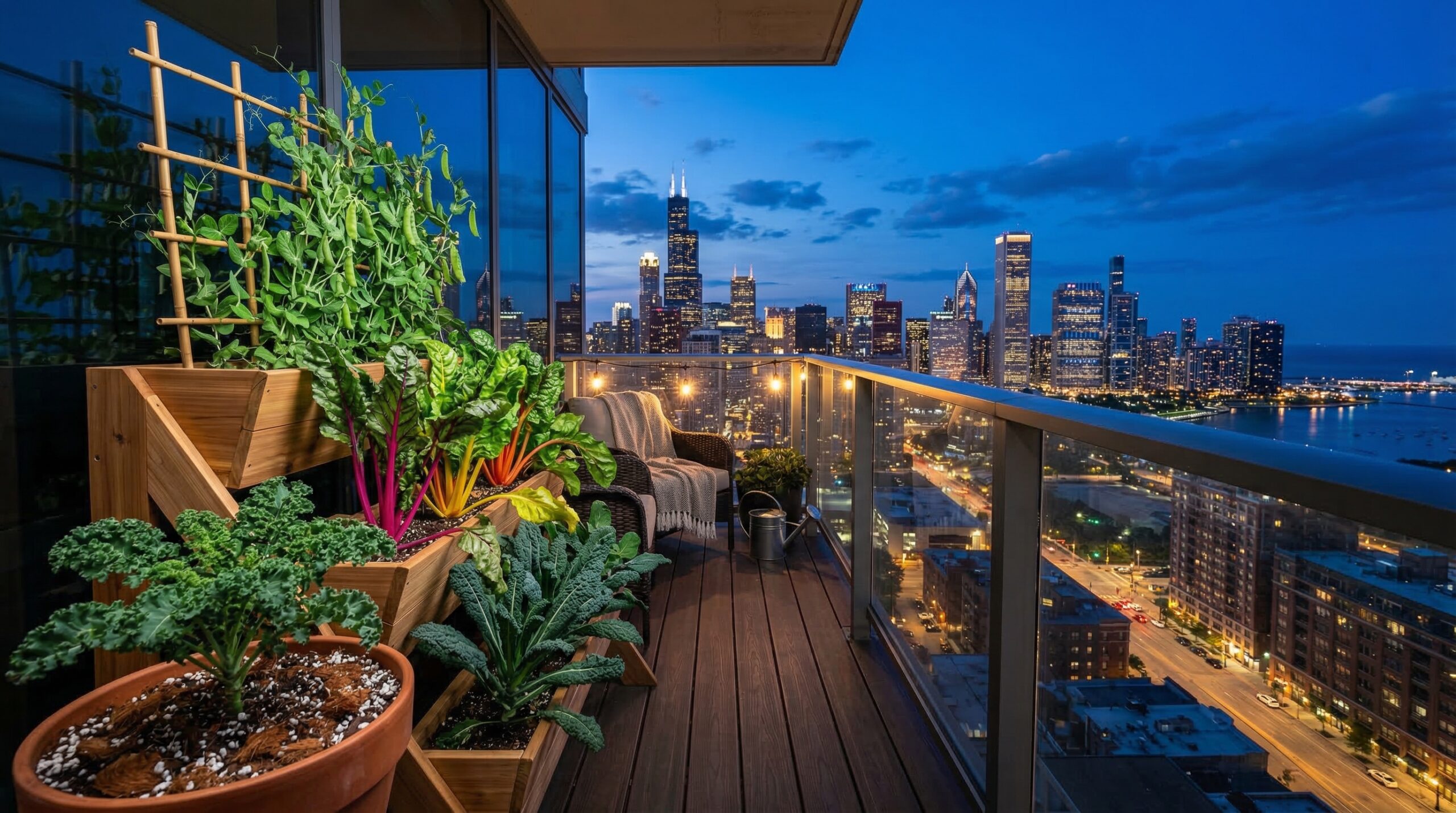
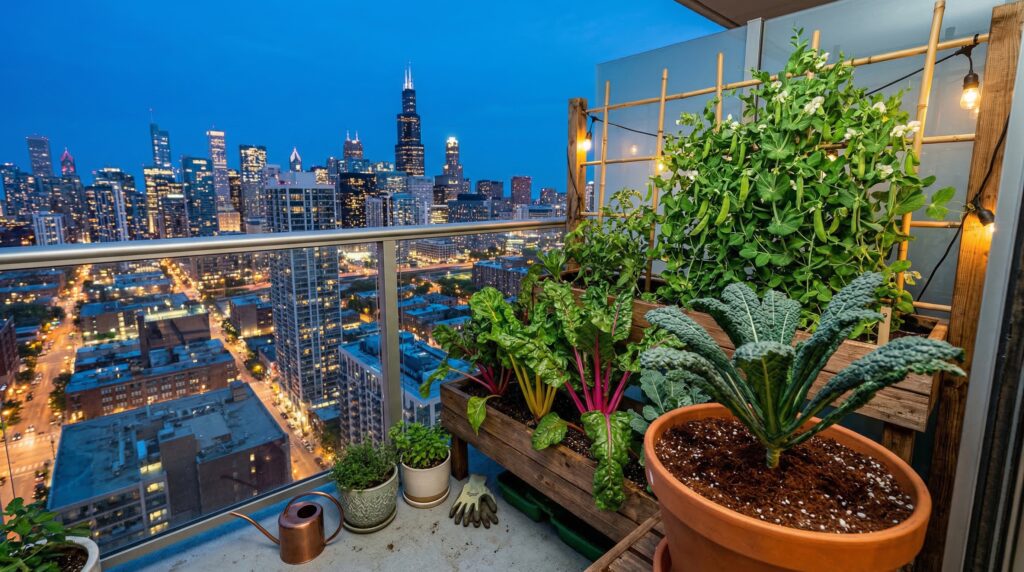
Will you picture this in your mind? You’re in a bustling New York City apartment, staring at a windowsill that’s more shadow than sun. Your first attempt at growing tomatoes ended in a soggy mess from overwatering in a too-small pot. Sound familiar? As someone who’s turned a tiny Chicago high-rise balcony into a mini farm after several failed seasons, I get it—urban vegetable gardening can feel daunting for beginners.
But here’s the good news: You don’t need a sprawling backyard or endless hours. With the right easy vegetables, quality soil, and a bit of LED help for those dim corners, you can harvest fresh, homegrown eats right from your condo or balcony. In this guide, you’ll discover my top 7 easiest vegetables for urban beginners, complete with soil setup, light strategies, and real-world tips to get from seed to supper without the heartbreak.
Why Urban Beginners Should Start with These Vegetables
Urban spaces like Toronto condos or Vancouver patios come with built-in hurdles: limited square footage, erratic balcony wind exposure, and often just 4-6 hours of direct sunlight. Traditional gardening advice doesn’t always fit, but container vegetable gardening does.
According to the National Gardening Association, over 35% of U.S. households now grow food in small spaces, proving it’s accessible. These seven picks are forgiving, fast-maturing, and thrive in pots or indoors under LEDs—ideal for small backyard spaces or apartment indoor plant care.
The Role of Soil and LEDs in Success
Good soil provides drainage and nutrients without compacting in containers. LEDs mimic sunlight efficiently, delivering the right spectrum for photosynthesis without the heat that scorches balcony plants. I’ll break it down as we go.
The 7 Easiest Vegetables: Profiles and Growing Tips
I’ve selected these based on my own trials—veggies that bounced back from neglect and delivered quick wins. Each thrives in 1-5 gallon containers, tolerates urban quirks, and matures in 30-60 days.
- Radishes: The Speed Demon
Radishes are the ultimate gateway crop. They sprout in 3-5 days and are ready to pull in 25-30 days, perfect for impatient beginners.
- Why Easy in Urban Settings: They handle partial shade and cool temps, common in high-rise balconies. No staking needed.
- Soil Setup: Use a loose, well-draining potting mix with added sand or vermiculite for root space. Aim for pH 6.0-7.0.
- Light Guide: 4-6 hours of sun or equivalent LED (full-spectrum, 20-30 watts). In low-light apartments, position under a clip-on LED for 12 hours daily.
- Urban Tip: In windy Chicago spots, plant in deeper 6-inch pots to anchor against gusts. Harvest when roots are golf-ball sized to avoid bitterness.
- Lettuce: Crisp and Continuous
Leaf lettuce varieties like loose-leaf or romaine grow loose heads that you can snip ongoing, yielding salads for weeks.
- Why Easy: Bolt-resistant types (that don’t flower prematurely in heat) suit erratic urban weather. Succession plant every two weeks for steady supply.
- Soil Setup: Moist, fertile soil with compost. In containers, mix 50% potting soil and 50% compost to retain water without sogginess.
- Light Guide: Thrives in 3-5 hours of indirect light. For indoor veggie growing, use cool-blue LED panels (14-20 watts) to prevent legginess in dim NYC apartments.
- Urban Tip: Balcony wind dries leaves fast—mist daily or use a humidity tray. My Toronto setup produced three months of greens from one 12-inch pot.
- Spinach: Nutrient Powerhouse
This leafy green is cold-hardy and regrows after cutting, making it forgiving for small-space vegetable gardening.
- Why Easy: Tolerates shade and matures in 40-50 days. Great for fall/winter in USDA Zones 5-9.
- Soil Setup: Rich, slightly alkaline soil (pH 6.5-7.5). Amend with organic matter; avoid heavy clay mixes that compact in pots.
- Light Guide: 4 hours sun or LED equivalent. In shaded Vancouver urban gardens, I supplemented with adjustable arm LEDs to hit 10-12 hours, boosting flavor.
- Urban Tip: Watch for aphids in enclosed balconies—rinse leaves weekly. Bolting from heat? Shade cloth helps.
- Microgreens: Instant Gratification
Not full veggies, but tiny versions of broccoli, radish, or pea shoots—ready in 7-14 days. They’re a smart starter for indoor plant care.
- Why Easy: No transplanting; grow in shallow trays. High yield from minimal space.
- Soil Setup: Seed-starting mix or coconut coir for sterility. Shallow 1-inch depth suffices.
- Light Guide: Low-light tolerant; use grow lights (10-15 watts) for 12-16 hours if windows are north-facing.
- Urban Tip: In cramped apartments, stack trays vertically. My first batch flavored soups and saved on store-bought greens.
- Cherry Tomatoes: Compact Fruiters
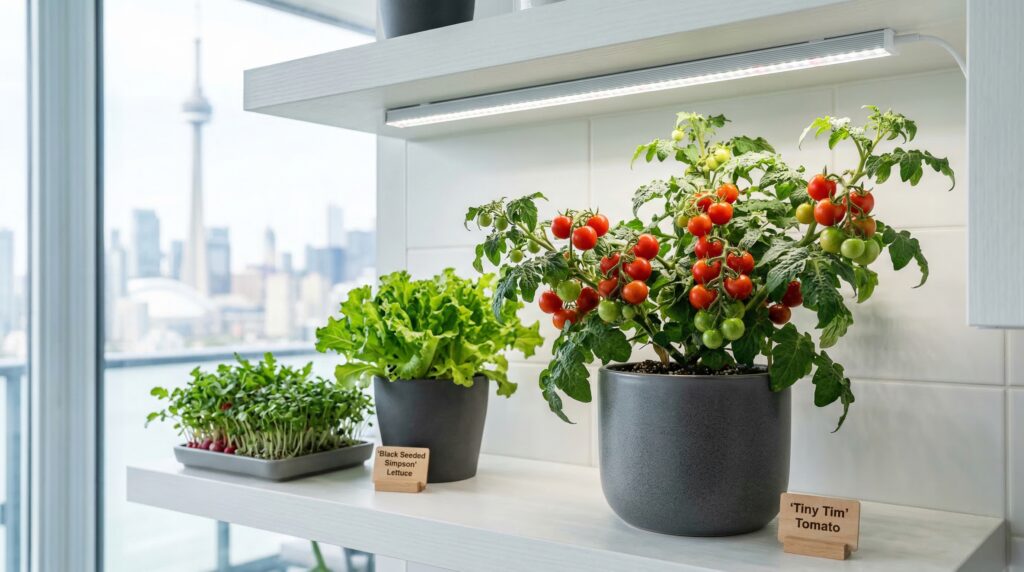
Opt for patio or balcony varieties like ‘Tiny Tim’—they stay under 2 feet and produce in 50-60 days.
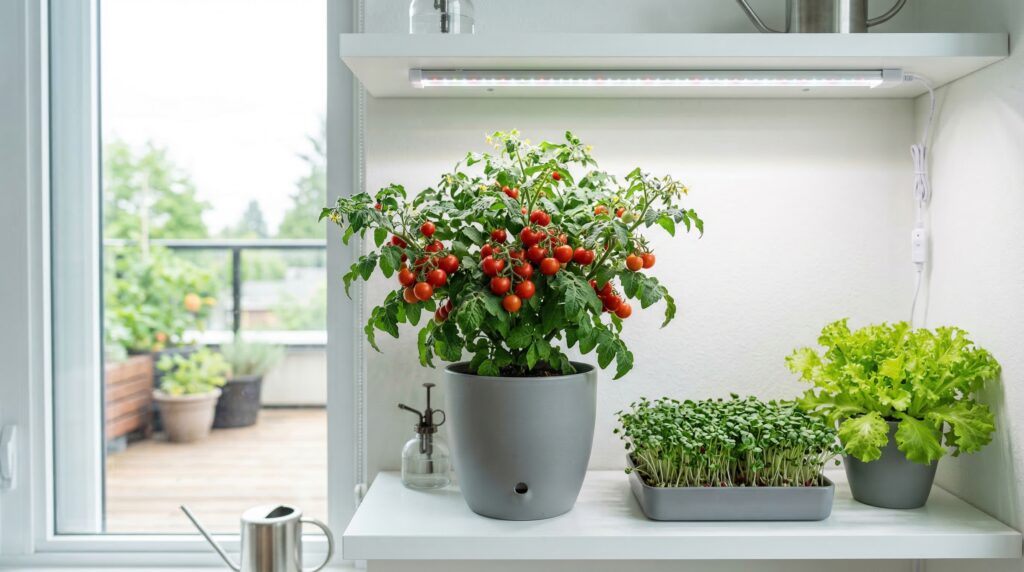
- Why Easy: Self-pollinating and disease-resistant dwarfs fit containers. Indeterminate types keep fruiting.
- Soil Setup: Well-draining mix with perlite. Fertilize with a balanced 10-10-10 every two weeks.
- Light Guide: Needs 6+ hours; LEDs (full-spectrum, 40-60 watts) are lifesavers for indoor setups. Position 12-18 inches above plants.
- Urban Tip: Stake against wind in high-rises. Prune suckers for better airflow in humid condos.
- Bush Beans: Protein-Packed Pods
Green beans in bush form (no trellis) mature in 50 days, offering fresh snaps without sprawling.
- Why Easy: Fix their own nitrogen, improving soil. Heat and drought tolerant once established.
- Soil Setup: Neutral pH 6.0-6.5; light, loamy potting soil. Inoculate seeds with rhizobia for better yields.
- Light Guide: Full sun preferred, but 5 hours plus LEDs works. Use warm-spectrum lights for flowering.
- Urban Tip: Plant in groups for pollination. In small backyards, interplant with lettuce for space efficiency.
- Kale: Tough and Tasty
Curly or baby kale withstands urban cold snaps and pests, harvesting leaves over months.
- Why Easy: Grows in poor soil and partial shade; cut-and-come-again method extends seasons.
- Soil Setup: Fertile, well-drained with calcium to prevent tip burn. Mix in lime if needed.
- Light Guide: 4-6 hours; LEDs prevent etiolation in low-light. Cool temps enhance sweetness.
- Urban Tip: Wind exposure toughens leaves—protect young plants with screens on balconies.
Urban Vegetable Success
The University of California Agriculture and Natural Resourcesnotes that container veggies can yield 10-20 pounds per square foot annually with proper care—far more efficient than traditional plots. The Royal Horticultural Society emphasizes starting with these cool-season crops for beginners, as they forgive watering inconsistencies common in apartment living.
In my experience, tracking soil pH with a simple kit (around $10) prevented 80% of my early failures, aligning with USDA recommendations for urban micro-farms.
Practical Implementation Guide: From Seed to Soil Setup
Getting started doesn’t require fancy tools. Here’s a step-by-step for your DIY garden project.
Step 1: Assess Your Space
Measure sunlight hours with a phone app. For limited sunlight, budget $20-50 for basic LEDs. Choose pots with drainage holes—terracotta for breathability in windy spots.
Step 2: Prepare the Soil
Mix 60% potting soil, 30% compost, and 10% perlite for aeration. Sterilize by baking at 180°F for 30 minutes to kill urban pests. Fill pots to 1 inch below the rim.
Step 3: Sow and Light
Plant seeds per packet depths (e.g., 1/4 inch for lettuce). For LEDs, hang 12-24 inches above, running 12-16 hours on a timer. Water gently to keep soil moist but not waterlogged.
Step 4: Maintain and Harvest
Water when the top inch is dry; fertilize bi-weekly. Thin seedlings for space. Harvest outer leaves first to encourage growth.
Risk: Overwatering leads to root rot—use saucers but empty excess.
Common Mistakes to Avoid
Beginners often stumble here, but learning from my errors saves time:
- Skipping Drainage: Pots without holes drown roots in rain-heavy urban weather. Always elevate on feet.
- Wrong Light Timing: Too little LED exposure causes weak stems. Aim for consistent cycles to mimic nature.
- Crowding Plants: Overpacking containers stunts growth. Follow spacing: 4-6 inches for greens, 12 for tomatoes.
- Ignoring Pests Early: Aphids love balcony herbs—inspect weekly and use neem oil sprays.
Expert Tips from Urban Trials
After seasons of tweaking in real urban gardens, these insights helped:
- Succession sow radishes and lettuce every 10-14 days for non-stop harvests.
- For balcony wind exposure, group pots in clusters to create a windbreak.
- Rotate crops seasonally: Kale in fall, beans in summer, to build soil health without depletion.
- Track progress with a journal—note what works in your microclimate for next year.
The “Seed Now” Advantage
One of the hardest parts for a beginner is knowing which seeds are actually fresh. I used to buy packets from the “clearance” bin, only to realize later that the germination rate was under 20%.
Why I Use Seed Now:I’ve switched almost 90% of my urban garden to Seed Now for three reasons:
- The Variety Packs: They offer “Container Garden” and “Urban Homestead” bundles specifically curated for small spaces.
- Germination Guarantees: Their seeds are tested for the current season. When I plant a row of their lettuce, I get a 95% sprout rate.
- The Packaging: They use moisture-proof resealable packs, which is vital in humid apartment environments.
If you want to stop guessing and start growing, I’ve curated a “Smart Urban Garden Starter Kit” on the Seed Now platform. It includes all seven survivors mentioned in this article, plus a bonus packet of marigolds to keep the bugs away.
Smart Wealth Habits: Growing Savings from Your Balcony
Urban gardening isn’t just a hobby—it’s a savvy wealth habit. Fresh produce from a $30 seed investment can replace $200+ in grocery bills annually, per National Gardening Association data. It builds self-sufficiency, reducing reliance on pricey organic markets. Plus, the mental boost from tending plants? That’s priceless ROI on stress reduction, indirectly supporting better financial focus.
In 2026, food inflation is a reality.
- The Investment: A $3.00 packet of Seed Now lettuce seeds contains roughly 500 seeds.
- The Yield: If only 10% of those grow to maturity, you have 50 heads of lettuce.
- The Savings: At an average city price of $4.50 per organic head, that’s $225.00 of value from a $3.00 investment. That is an ROI that crushes any traditional savings account. Growing your own greens is effectively a tax-free “wealth habit” from your kitchen.
Comparison Section: Veggie Quick-Guide
|
Vegetable |
Sunlight Needs |
Difficulty (Beginner Scale 1-5) |
Best Container Size |
Time to Harvest |
Urban Challenge Fit |
|
Radishes |
4-6 hours |
1 |
6-8 inches deep |
25-30 days |
Wind-resistant roots |
|
Lettuce |
3-5 hours |
2 |
10-12 inches wide |
30-45 days |
Shade-tolerant leaves |
|
Spinach |
4 hours |
2 |
8-10 inches |
40-50 days |
Cool-weather hardy |
|
Microgreens |
4-6 hours (LED) |
1 |
Shallow tray (2 inches) |
7-14 days |
Indoor space-saver |
|
Cherry Tomatoes |
6+ hours (LED boost) |
3 |
5 gallons |
50-60 days |
Compact fruiter |
|
Bush Beans |
5-6 hours |
3 |
12 inches wide |
50 days |
Self-fertilizing |
|
Kale |
4-6 hours |
2 |
10-12 inches |
50-60 days |
Pest-resistant |
Frequently Asked Questions (FAQ)
What are the easiest vegetables for urban beginners with limited space?
Radishes, lettuce, and microgreens top the list. They mature quickly (under 45 days), fit in 6-12 inch pots, and tolerate partial shade common in apartments.
Can I grow vegetables indoors using LED lights?
Yes, full-spectrum LEDs provide the necessary PAR for photosynthesis. Run them 12-16 hours daily, 12-18 inches above plants, for veggies like spinach or cherry tomatoes in low-light setups.
What soil is best for container vegetable gardening on a balcony?
A mix of 60% potting soil, 30% compost, and 10% perlite ensures drainage and nutrients. Avoid garden soil, which compacts and harbors urban pests.
How do I protect balcony vegetables from wind?
Use heavier pots, plant windbreaks like kale around edges, and install mesh screens. Group containers to reduce exposure in high-rises.
What if my apartment gets less than 4 hours of sun?
Supplement with affordable LED grow lights (20-40 watts). Lettuce and spinach thrive under them, yielding harvests without natural light.
Are these vegetables suitable for small backyard spaces too?
Absolutely. Their compact growth suits patios or 4×4 foot areas. Bush beans and kale maximize vertical space with minimal spread.
How often should I water urban container veggies?
Check soil daily—water when the top inch is dry. Balconies dry faster due to wind, so aim for consistent moisture without sogginess.
Can beginners grow these without prior experience?
Yes, these are forgiving. Start with seeds in spring; follow packet instructions. My first radish crop succeeded despite zero prior knowledge.
Conclusion
From seed packets to your plate, these seven easiest vegetables prove urban beginners can conquer container gardening. With smart soil mixes and LED support, you’ll navigate limited sunlight and space like a pro. Don’t wait for perfect conditions—grab some pots and start sowing. Your first harvest will hook you on the fresh flavors of homegrown success.
Key Takeaways
- Start Fast: Radishes and microgreens deliver quick wins in 1-4 weeks, building confidence.
- Light Smart: Use LEDs to extend growing seasons in shaded urban spots—essential for apartments.
- Soil Matters: Well-draining mixes prevent common root issues in containers.
- Harvest Often: Cut-and-come-again methods like for lettuce keep production rolling.
- Adapt to City Life: Wind and space tweaks make these veggies resilient for balconies and indoors.
